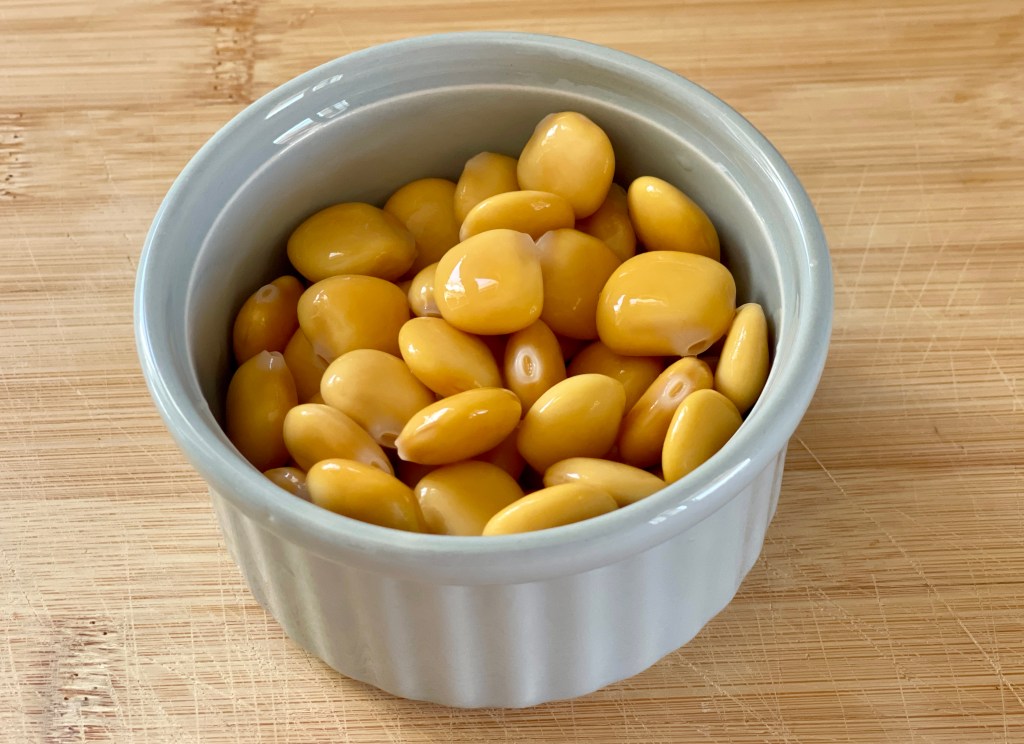
Why did we stop eating it?
Every so often I come across a food that makes me stop and wonder:
Lupins have been nourishing people for thousands of years. They grow well in poor soils, are packed with nutrients, and yet today, when I ask people if they’ve ever heard of them, many haven’t.
If you grew up in Greece, you may remember them sitting in large glass jars at the grocery store or being sold at village festivals. They were a simple snack, often enjoyed with a little salt and a glass of wine.
In many Mediterranean countries, however, they had another purpose too. Farmers also grew them as a valuable source of protein for their animals. Today, in fact, a large percentage of the world’s lupin crop is still used as livestock feed.
Perhaps that’s one reason we forgot how valuable they are as food for ourselves.
Now nutrition science seems to be catching up with what tradition already knew.
What makes lupins unique is not just their nutritional value but the combination of nutrients they provide.
A 100-gram serving of cooked lupins provides approximately:
- 16–18 g protein
- 15–16 g fiber
- Relatively few digestible carbohydrates
- Healthy unsaturated fats
- Magnesium
- Potassium
- Iron
- Manganese
- Copper
- Folate
Unlike many plant foods that are high in carbohydrates, lupins are naturally rich in protein and fiber while remaining relatively low in digestible carbohydrates. That combination makes them remarkably satisfying. They fill you up instead of sending you looking for another snack an hour later.
Among commonly eaten legumes, lupins are second only to soybeans in protein content. Unlike most beans and lentils, they also contain relatively little starch and an exceptional amount of fiber, making them both satisfying and nutritionally unique.
Like most legumes, lupins contain all of the essential amino acids but are naturally lower in methionine. Years ago, people were advised to combine legumes with grains such as rice at the same meal. Today we know that’s generally unnecessary. As long as your diet includes a variety of protein-rich foods over the course of the day, your body has what it needs.
For anyone trying to eat less sugar, support healthy blood glucose, lose weight, or simply stay full longer, that’s an impressive nutritional package.
But nutrition labels only tell part of the story.
Fiber isn’t very exciting until you realize what it does.
It feeds the trillions of microorganisms living in our gut. Those tiny organisms are now known to influence far more than digestion—they play a role in our immune system, metabolism, and even our mood.
Protein matters too, especially as we grow older. Maintaining muscle isn’t only about lifting weights. Our bodies also need enough high-quality protein every day to repair and rebuild.
What I appreciate most about lupins, though, is something much simpler.
They make healthy eating easier.
When I’m hungry, I don’t always need more willpower. I need better food within reach. A bowl of prepared lupins in the refrigerator is far more useful than another lecture about discipline.
There is one important thing to know.
If you’ve bought lupins in a jar, they’re ready to eat after a quick rinse. Rinsing also helps remove some of the excess salt. Keep in mind, however, that they are usually preserved in a salty brine and many brands also contain additives such as citric acid (E330) and the preservative sodium benzoate (E211).
If you’ve bought dried lupins, the preparation depends on the variety.
Traditional bitter lupins contain naturally occurring alkaloids that make them extremely bitter—and potentially unsafe to eat—unless they are properly prepared.
The traditional method requires patience.
Soak the dried lupins in plenty of water for 24 hours. Drain them, cover with fresh water, and simmer until tender, about 1–2 hours. Drain again, then place them in a large bowl of fresh water and change the water twice a day for 5–7 days, tasting one each day. Once all the bitterness has disappeared, they’re ready to eat.
To store them, place the prepared lupins in a container of lightly salted water in the refrigerator. The salt helps preserve them, and they’ll keep well for several weeks. Just remember to give them a quick rinse before serving if you prefer a less salty taste.
Interestingly, modern sweet lupin varieties have become popular in countries such as Australia, where they’re used to make everything from flour to pasta and high-protein snacks.
Perhaps that’s another lesson hidden inside this little bean.
Some things are worth waiting for.
Once prepared, lupins are wonderfully versatile. Enjoy them with a little lemon, toss them into salads, blend them into a creamy dip, add them to soups, roast them with olive oil and spices, or even use sweet lupin flour in gluten-free baking.
And here’s one more reason to appreciate them.
Lupins don’t just nourish us—they nourish the soil. Like other legumes, they work together with bacteria in the soil to capture nitrogen from the air and naturally enrich the ground. Farmers have known this for generations, using lupins to improve the soil for the crops that follow.
Healthy food.
Healthier soil.
Sometimes the simplest answers have been with us all along.
So why did we stop eating them?
Perhaps because they take time to prepare.
Perhaps because processed foods replaced many traditional foods.
Perhaps because something that was once considered “ordinary” no longer seemed interesting.
Or perhaps because we forgot that some of the best foods don’t need clever marketing.
They simply need remembering.
I’m not suggesting lupins are a miracle food.
There is no such thing.
But I do think they’re one of those rare foods that deserve a place back on our tables.
Sometimes the future of healthy eating isn’t about discovering something new.
Sometimes it’s about rediscovering something old.
Note: As always, I’m simply sharing what I’m learning and what I find interesting. This post is not medical advice. If you have a peanut allergy, please speak with your healthcare provider before trying lupins, as cross-reactivity can occur.
 Kiki's Memos
Leave a comment